
Finding Dakota County Residents From a Name or Address
Start with what you already know. An address or parcel number opens the fastest path through the Dakota County Property Information Search, which pairs each entry with a property card. A name works differently. You can run it through the statewide Minnesota Court Records Online tool, a historical collection, or the exact-field Find My Registration service. No single source in Dakota County lists every person at an address, so treat each lookup as one piece of a larger puzzle.
Read the evidence on its own terms. A property card names an owner of record plus a tax-mailing contact, nothing more. A voter result only confirms an exact registration query. Court and archival entries tie a name to a role or an event in the record. Renters, other household members, protected voters, and Safe at Home participants may simply never surface. That means a missing result is never proof a person lives outside Dakota County.
- Normalize an address in the county property search, then save the Parcel ID, municipality, and the date checked.
- Read the owner, situs, and mailing fields as property relationships, not an occupancy list.
- For a recorded land trail, use the parcel details and legal description in RecordEASE.
- For an exact current registration question, use the Secretary of State lookup with the required name, date of birth, and address fields.
- For an older household, move to the library, Minnesota Historical Society, or Dakota County Historical Society and preserve the collection year.
Note: Label every Dakota County residents directory result by its true source relationship and date before you rely on it.
Dakota County Offices Behind Resident Records
Several custodians hold the pieces of a Dakota County residents directory trail. Property Taxation & Records keeps the property cards and recorded land documents. District Court Administration holds court files. MCRO serves as the statewide remote route. The Elections Office runs local election activity. The Secretary of State controls the registration lookup and voter-list requests. For historical questions, the county library, DCHS, and MNHS are the practical route. Know which office holds which record and the trail becomes far easier to follow.
Dakota County Property Search
Address or Parcel ID
Countywide parcel records
651-438-4576
Dakota County Parcel Cards Start With an Address
The county property tool is the clearest address-to-parcel route. Its public help describes full or partial address searching. Parcel ID entry works with or without dashes. A matching-result list appears before any card opens. The card can show the owner and mailing address. It can also show the municipality, tax description, school and watershed districts, plus tax and building panels. Printable property details, tax-statement material, and subdivision-plat links round it out. Note the selected parcel and the check date before moving on. The interface documents no owner-name search, so a person-first question needs a different record branch.
| Property field | Input or panel | Use it for |
|---|---|---|
| Street address | Full or partial address | Finding the matching parcel |
| Parcel ID | PID, with or without dashes | Reopening a known parcel |
| Property panel | Owner, mailing address, municipality | Recorded property context |
| Tax and building panels | Linked result tabs | Tax and building leads, when displayed |
Property data has a firm boundary. A mailing address may belong to a business, an escrow arrangement, or any tax contact. It does not prove a person occupies that Dakota County address.
Dakota County Deed Trails and Future Filing Alerts
RecordEASE is the county land-record path for documents tied to a parcel or party. Its abstract computer index begins July 8, 1993, with separate Abstract and Torrens status queues. Start from a property card and keep the legal description. Identify the current deed and its grantee. The grantor then becomes the next name to test as a prior grantee. Older records may require county staff, books or microfilm, DCHS, MNHS, or a title professional.
The county's Property Watch service looks forward rather than backward. It can monitor a name, an entity, a legal description, and an email address. These track later recording events. Common names generate broad notices. A legal description is the more precise enrollment choice. See the Property Watch page before signing up for any future-recording alert.
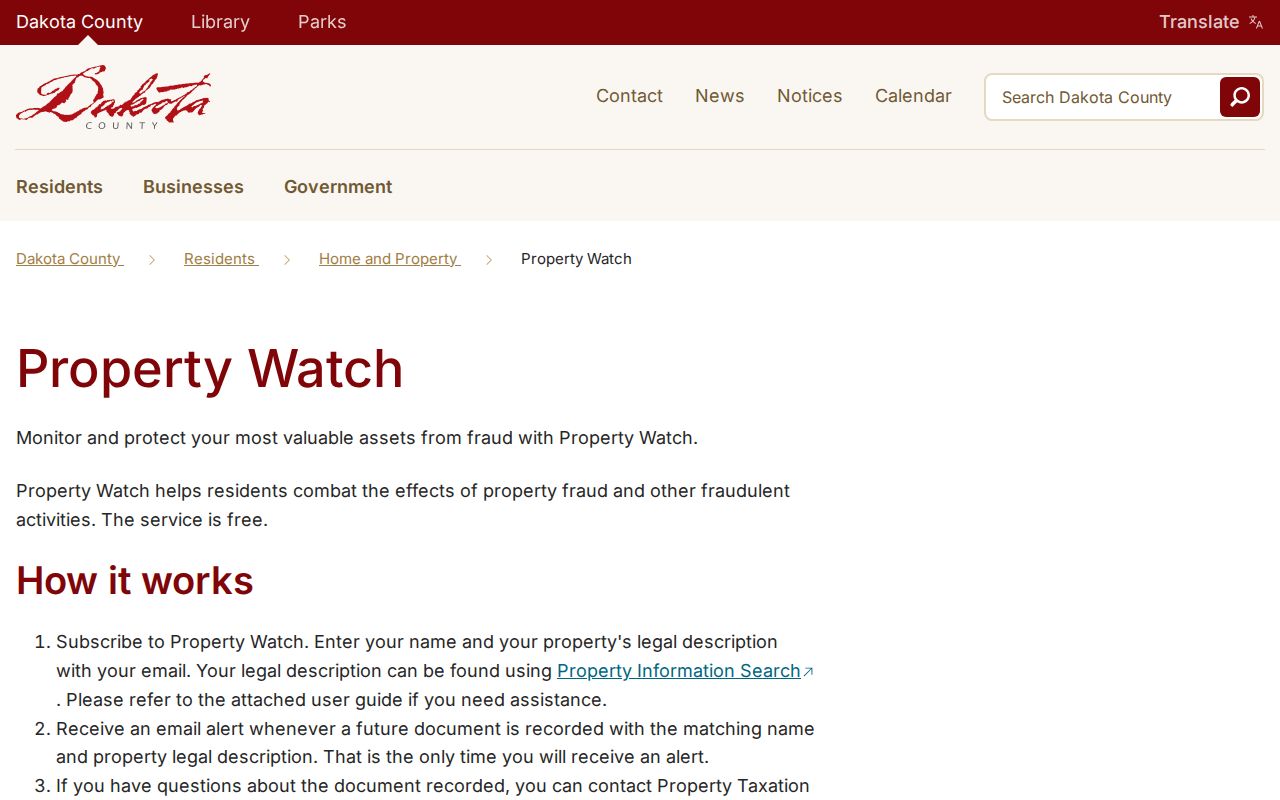
The service helps a property owner watch newly recorded documents. It cannot rebuild a prior chain of title.
- Parcel
- A county identifier for a piece of land, used to join the property card, map, and tax context.
- Index
- A finding aid that points to a document or record; it is not automatically the certified document itself.
- Grantor and grantee
- The recorded transferor and recipient named in a land instrument.
- Criss-cross directory
- An address-ordered directory section that can supply a historical household lead.
Note: Abstract and Torrens land follow different title routes, so save the parcel's title-system indicator before reading a deed trail.
Current Dakota County Resident Record Paths
Current Dakota County resident records are relationship-specific. A property card names an owner of record plus parcel details. RecordEASE names parties to recorded documents. MCRO names public case participants when remote access permits. The state registration tool answers one specific voter query, while a voter-list product carries statutory request, certification, and use limits. Each record answers only the question it actually addresses.
| Record path | Relationship shown | Custodian | Access boundary |
|---|---|---|---|
| Property Information Search | Owner, mailing and parcel context | Dakota County | Address or PID, not an occupant roster |
| RecordEASE | Recorded instrument parties | Property Taxation & Records | Account or fees; index begins 07/08/1993 |
| Find My Registration | Exact current registration match | Minnesota Secretary of State | Full identity and address fields required |
| MCRO | Public court party and case event | Minnesota Judicial Branch | Unofficial remote record with exclusions |
| Municipal permit file | Project, applicant, or property role | Relevant city or township | City-by-city access and coverage |
For a one-person question, the Dakota County resident lookup path separates property, court, vital, and historical evidence. It does not treat any single result as conclusive. A municipal permit can name an owner, applicant, or contractor. None of those roles proves present residence. The correct municipality comes from the county parcel card. Dakota County has no countywide permit system.
Dakota County Voter Data Has a Narrow Purpose
Minnesota's live registration lookup answers one question only: is this person registered? It was never built as a residents directory. It will not let anyone browse a Dakota County roster. The form demands a first name, last name, full date of birth, city or township, house number, and street. It also requires either the ZIP or the county route. Updates run nightly. A brand-new registration can still take up to 14 days to process. A no-match may simply mean a spelling slip, a missing unit, or an address-path quirk rather than a real conclusion.
Voter-list products sold under Minn. Stat. §201.091 play by different rules. A product may carry a name, address, birth year, voting history, a supplied phone, and district information. It never includes a full date of birth or listed government identifiers. Requesters must satisfy the statutory conditions, pick a product and a geography, and pay the applicable charge. They must also honor the permitted-use limits. Safety withholding can also change or suppress an address on purpose.
| Required identity | First name, last name, and full date of birth |
|---|---|
| Required location | City or township, house number, street, plus ZIP or county path |
| Optional unit | Apartment or unit field becomes required when selected |
| Response | Registration confirmation and voting information |
Use the official Minnesota voter lookup only for its stated registration-confirmation function.
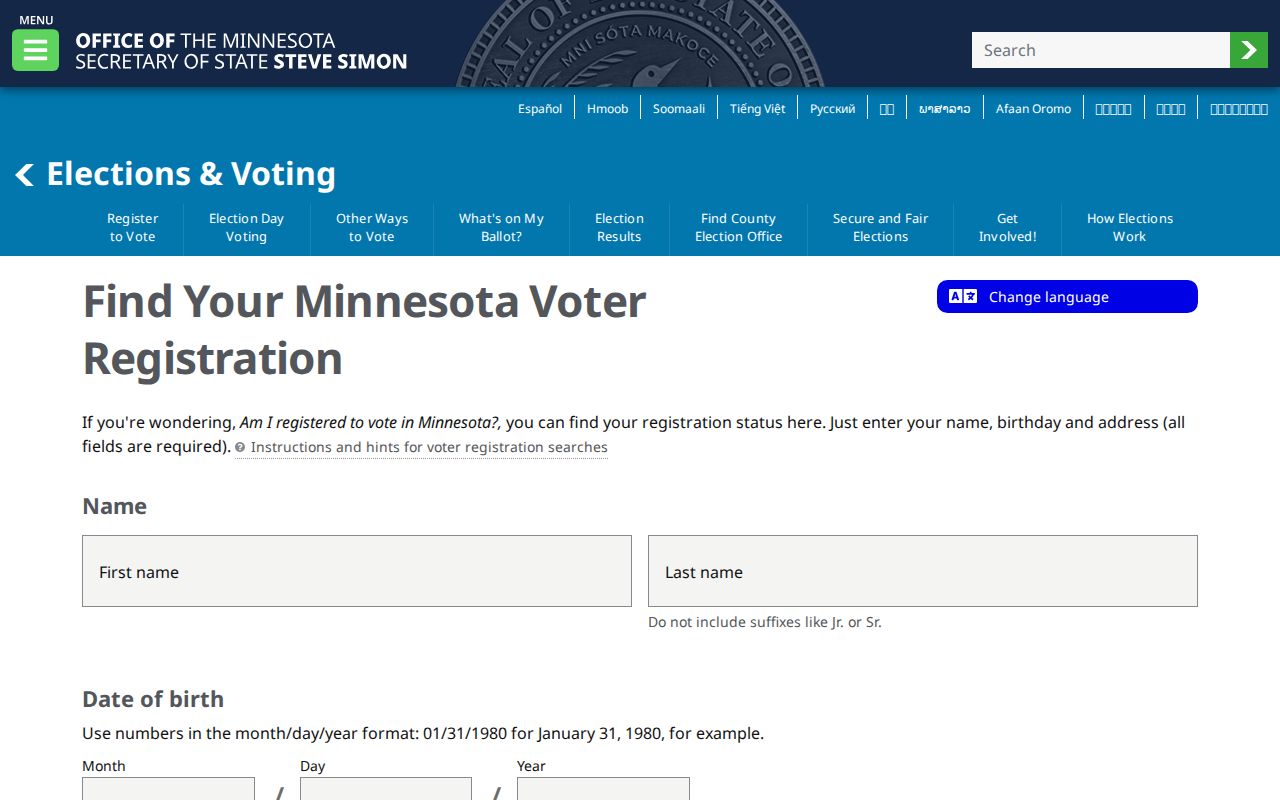
So the required fields are the point. An address alone cannot yield a lawful statewide voter roster from this lookup.
Dakota County Court and Vital Record Branches
MCRO is the natural starting point for public Minnesota district-court cases from a distance. Its fields cover name, case number, citation, attorney, category, status, filing date, and court location. Treat remote records as unofficial. Documents from before July 1, 2015 are limited, and sensitive case categories may be excluded entirely. For certified copies, locally held paper files, or anything not available remotely, Dakota County District Court Administration and the courthouse public terminals are the follow-up route.
Vital records split along their own custody lines. Dakota County vital offices issue eligible records. The Minnesota Department of Health handles statewide services and designated adoption services. A marriage certificate comes from the licensing county, while a divorce decree comes from the granting court. Birth access is restricted under Minn. Stat. §144.225, death records are public even though certificate eligibility still matters, and adopted-person access follows §144.2252. Historical MNHS indexes can surface a lead, but they never replace the underlying record.
Check the Minnesota vital-record forms and fee page for the correct request route before sending sensitive paperwork anywhere.
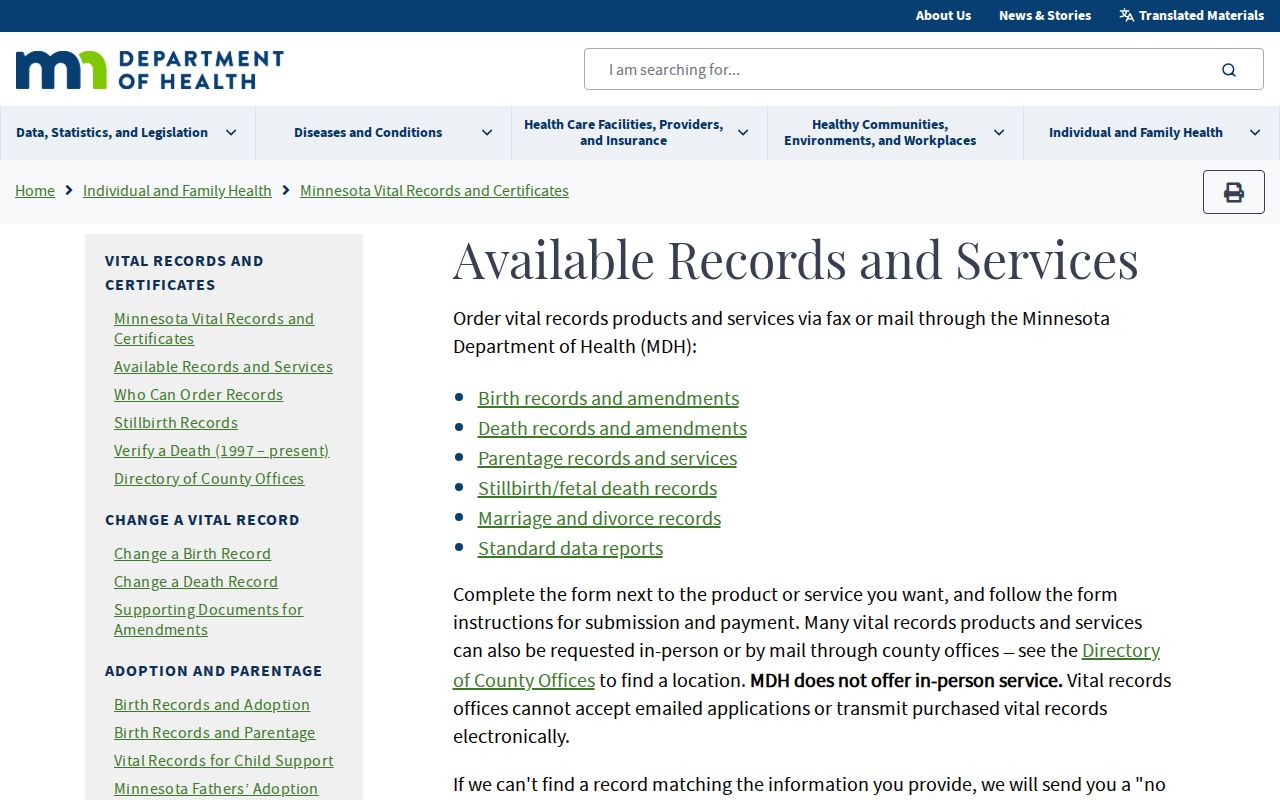
That paperwork step proves the point. An index hit and an eligible certificate request are always two separate steps.
Dakota County Libraries Keep the Older Resident Trails
For households that predate today's portals, three layers of records survive. Dakota County Library offers a research list. It includes HeritageQuest, America's News, Minnesota News Sources, and in-library Ancestry Library Edition. DCHS holds church, cemetery, census, obituary, marriage-announcement, clipping, photograph, and microfilm-newspaper collections. MNHS contributes People Records, state census material, telephone-directory finding aids, court-file research, and historical vital-record research.
The local gem is the digitized 1916 Dakota County Atlas and Farm Directory. Its township plats name the owners. MNHS's telephone-directory finding aid starts in 1928. It lists roughly 1,237 volumes plus 226 microfiche by city, year, and shelf. Exact city runs still need item-by-item checking. The fuller historical shelf lives on the Dakota County city directory page.
Ask the Dakota County Library or the Dakota County Historical Society about a specific year. Don't assume a volume is online.
Dakota County ZIP Codes Do Not Define Neighbors
A ZIP code map gives Dakota County useful postal context. But a postal city is not a legal neighborhood, a municipal boundary, or a parcel boundary. The county map identifies 23 ZIP codes. These cover Farmington, Hastings, Lakeville, Eagan, Apple Valley, Burnsville, and other county areas. Confirm exact delivery assignments through USPS. County GIS and the municipality named on a property card are better sources for the civic picture around an address. They also give the parcel picture.
A ZIP can narrow a search to the postal question. It cannot say who lives together or whether two hits share a neighborhood. The Dakota County ZIP code directory shows how the pieces fit together. It covers the county map, the USPS lookup, and parcel geography.
Minnesota Data Practices Requests Fill Gaps Carefully
When an identified public record is not online, a narrow request under the Minnesota Government Data Practices Act, Minn. Stat. ch. 13, is the right tool. Name the custodian. Give the address or parcel where relevant, plus the date range, record type, fields sought, and whether inspection or a copy is wanted. Minnesota generally allows inspection of public government data at reasonable times without an inspection fee, though copy, retrieval, and transmission charges can apply. Any denial should state its legal authority.
Start with the county's public-data request form and department routing whenever the responsible Dakota County department is known.
A focused request helps staff find a real record set. It avoids inviting assumptions about protected data.
Seeking your own government data is a different track. The county's data-subject request process requires written information and identity verification, and it describes a 10-business-day response framework.
That separate track never turns private government data into a public resident record.
Note: Minnesota's Safe at Home program and other confidentiality rules can make an address difference intentional rather than an error.
Dakota County’s Three County Seats Affect Old Searches
Dakota County dates to 1849. Its county seat did not stay put. Kaposia held the honor first. Then Mendota took over in 1854. Hastings has carried it since 1857. The county once covered far more ground than it does now. So an old record may point to a county-seat label, a township, an unorganized territory, or the archaic spelling “Decota.” Keep whatever spelling the index shows. Then test variants rather than quietly modernizing the entry.
Several sources line up well for tracing a Dakota County family or rural parcel through these shifting place names. The 1916 atlas, township records, and state-census material build a useful sequence. Telephone directories from 1928 forward round it out. River boundaries and municipal movement add another wrinkle. A search should cover the historical jurisdiction alongside the modern city name.
Past Dakota County Resident Directory Collections
An old directory entry proves a person appeared in that edition, not that they lived there all year. Treat it as a dated association. Telephone listings carried names and street numbers. A business reference might appear too. A criss-cross section works in reverse. It turns an address into an address-ordered lead. Before calling any household trail strong, pair the edition with a deed, census record, permit, newspaper notice, obituary, probate file, or cemetery source.
The MNHS telephone-directory finding aid is the county's best documented route. Its entries run from 1928 forward. Each one is organized by city and year. The 1916 atlas earns its keep earlier still. Its township plats name landowners. That matters before standardized street addresses existed. When a year has not been digitized, Dakota County Library staff and the DCHS research desk can help locate the right physical, microfilm, or database source.