
Dakota County Resident Lookup Record Paths
One name can surface in several Dakota County systems. Each answers a different question. A property card names an owner of record and a tax mailing address. But it does not list everyone living at the parcel. A court result shows a party role and public case activity, never identity or guilt. The Minnesota registration tool confirms a match only after every required person and address field is entered. Vital records and archives often serve family-history questions better. Treat any result as a time-stamped record connection. Seek a second official identifier before joining two records together.
| Record | What Confirms | Where | Access |
|---|---|---|---|
| Property and tax card | Owner of record, tax mailing address, parcel and situs context | Dakota County Property Information Search | Address or Parcel ID search; it is not an occupant list |
| Recorded documents | Recorded parties, legal description, and conveyance or encumbrance dates | RecordEASE | Account and fee routes; abstract index reaches back to 07/08/1993 |
| Registration confirmation | An exact current registration match and voting information | Minnesota Find My Registration | Required person and address fields; statutory limits and safety withholding apply |
| Court record | Public party role, case type, filing events, and disposition when public | Minnesota Court Records Online | Remote result is unofficial; some documents and case types are unavailable |
| Vital index or certificate | Birth, death, or marriage lead and qualifying certificate route | Minnesota Department of Health | Birth certificates have eligibility limits; death-copy rules still apply |
| Historical collection | Former address, household, obituary, cemetery, church, or community lead | Dakota County Historical Society | Collection dates and reading-room conditions vary |
Match the record to the detail you already have. An address or Parcel ID belongs in the county property search. Court questions start in MCRO. An old spelling, a death record, or an earlier household lead may point instead to the Minnesota Historical Society or the Dakota County Historical Society. Keep the source label intact. "Owner of record," "party in case," or "historical index entry" says far more than calling every match a current resident.
Dakota County Court Name Checks
Start a Dakota County name check at MCRO Case Search. It is the state court portal. Tabs cover Name, Case Number, Citation Number, and Attorney. The name tab takes name type with last, first, and middle fields. It also offers an optional Sounds Like option. It also offers exact or range choices for date of birth and filed date, along with case category, status, court location or county, case number, citation, and attorney. Try the middle initial. Try the no-middle-name version, punctuation variants, and a trailing wildcard after two characters. Sounds Like and a wildcard cannot be combined.
| MCRO field | How it narrows a Dakota County search |
|---|---|
| Name Type and last, first, middle | Starts an exact or variant name search |
| Sounds Like | Tests a name sound, but cannot be combined with a wildcard |
| Date of birth and filed-date ranges | Separates similarly named people by supplied dates |
| Case category and status | Limits a search to Civil, Criminal, Family, Probate, or Mental Health categories and a status |
| Court location or county | Focuses statewide results on Dakota County or another court location |
| Case, citation, and attorney number or name | Routes a known case or legal representative to the related result |
The official MCRO Case Search presents these record paths before a result is opened.
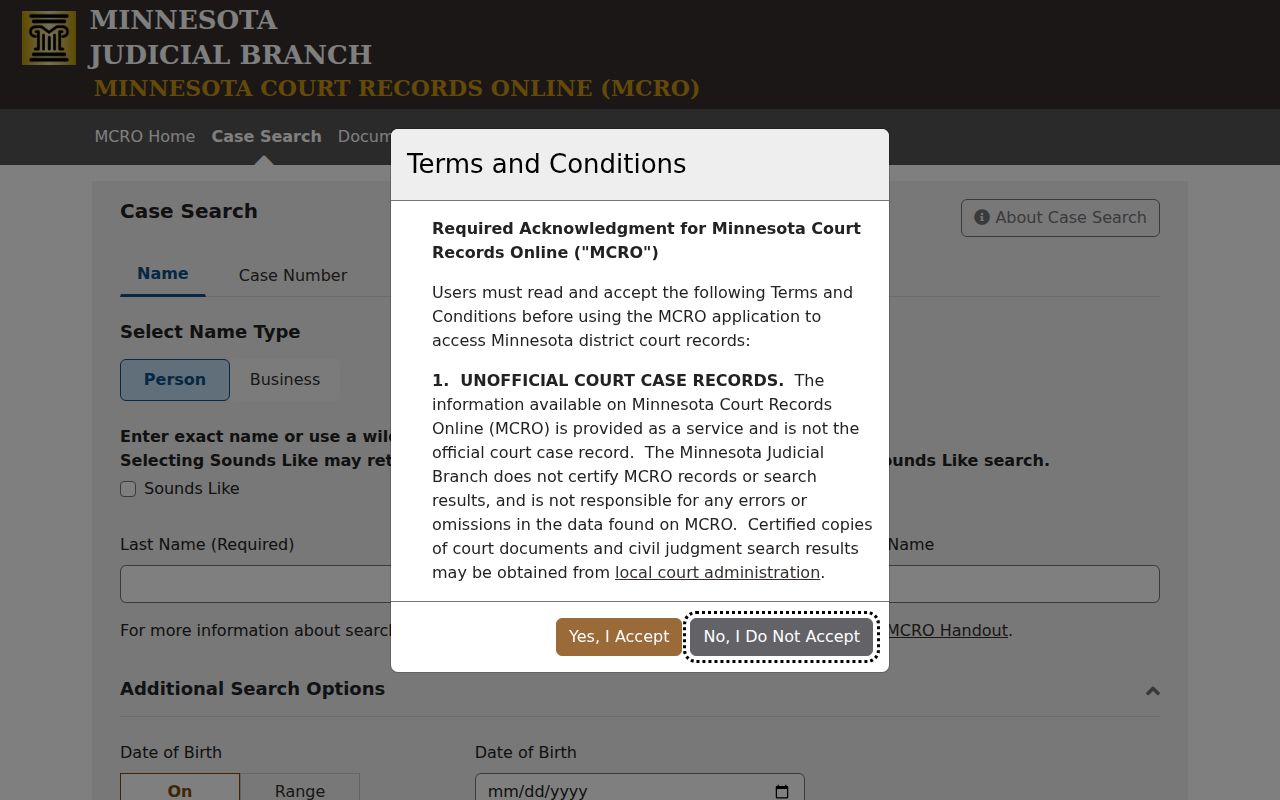
Treat location, category, filing date, party role, and result type as separate checks. An exact name alone is weak evidence. A common name spans multiple courts and categories.
Dakota County Records Complaint Window
Dakota County runs its own criminal complaint search. It is much narrower than MCRO. Only complaints posted within the last 12 months appear. You can search by last name, first name, or a posted-date range. The county leaves out complaints tied to specified sexual conduct. It also excludes complaints tied to child sexual abuse images. Charges listed here are not proof of guilt, the county cautions. Treat this rolling window as a quick view of current public filings. For the case category and any public disposition, go to the court record itself.
The Dakota County complaint portal is where these limited lookups happen, with its name and posted-date entry controls.
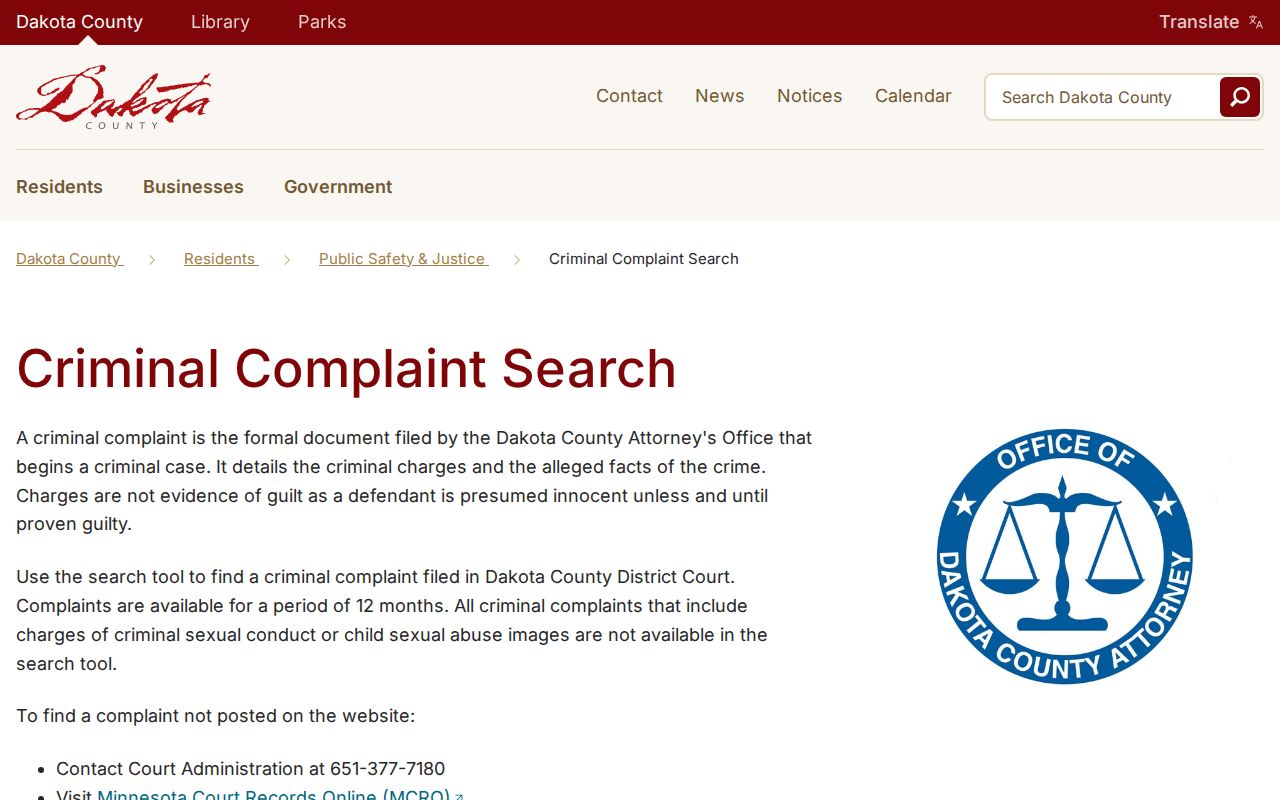
A complaint is an allegation, not a conviction. Stick to neutral record language, such as filing, defendant, party, hearing, judgment, or disposition, matching whatever the actual record shows.
Verifying a Dakota County Resident Lookup
Confirming a Dakota County resident lookup works best with two independent official identifiers. A parcel ID paired with an owner name builds a strong match. So does a court case number paired with a party role, or a vital certificate number with the event county. A ZIP code, an approximate age, or a shared surname is far weaker evidence on its own. Keep both spellings, the one you searched and the one returned. Old records may spell the county as Dakota, "Decota," a township name, or a former jurisdiction, so a mismatch in the residents directory often calls for a variant search rather than a quick conclusion.
- Start with the exact name and one non-sensitive anchor, such as a known municipality, dated address, parcel ID, case number, or family relationship.
- Use the county property search by address or Parcel ID when the question concerns a recorded parcel connection. Record the owner, mailing address, situs, and parcel context without treating the card as an occupant list.
- Run the MCRO name search with spelling and middle-name variants. Record the court location, category, filing date, displayed role, case number, and public result type.
- Check the appropriate vital, archive, or registration route only for the question it can answer. Compare the date and source coverage before associating a record with the person.
- Request a certified copy or older paper file from the responsible custodian when the distinction matters. An online hit is not a certified record.
- Docket
- A case’s recorded sequence of filings, hearings, and other court events, often shown through the register of actions.
- Index and image
- An index points to a record and its identifying fields. An image is the underlying document when public access permits viewing it.
- Certified copy
- A copy issued by the custodian as an official record. It is different from an unofficial remote search result.
Dakota County Court Record Details
When a public MCRO result opens for Dakota County, capture the details. These explain its scope, not just the name. The useful inventory includes the case number, court location, case category, and filing date. Record parties and roles exactly as displayed. Add register-of-actions events, hearing dates, document-index links, and any public judgment or disposition. Two limits matter. Remote results show no party street addresses or comment fields. A calendar entry marks a scheduled hearing, not necessarily a final result.
| Case number | The court identifier needed for a counter request or later verification |
|---|---|
| Location and category | The Dakota County court setting and record type attached to the result |
| Party role | The role displayed by the court, which should not be converted into a broader claim |
| Register of actions | The event history associated with the case |
| Documents and outcome | Public document-index links and judgment or disposition information when available |
Jail custody is its own record. The Dakota County jail inmate search shows who is currently in custody, with searchable fields for last name, first name, posted date, and court date. The county cautions that results are only an estimate, and positive identification requires fingerprints.
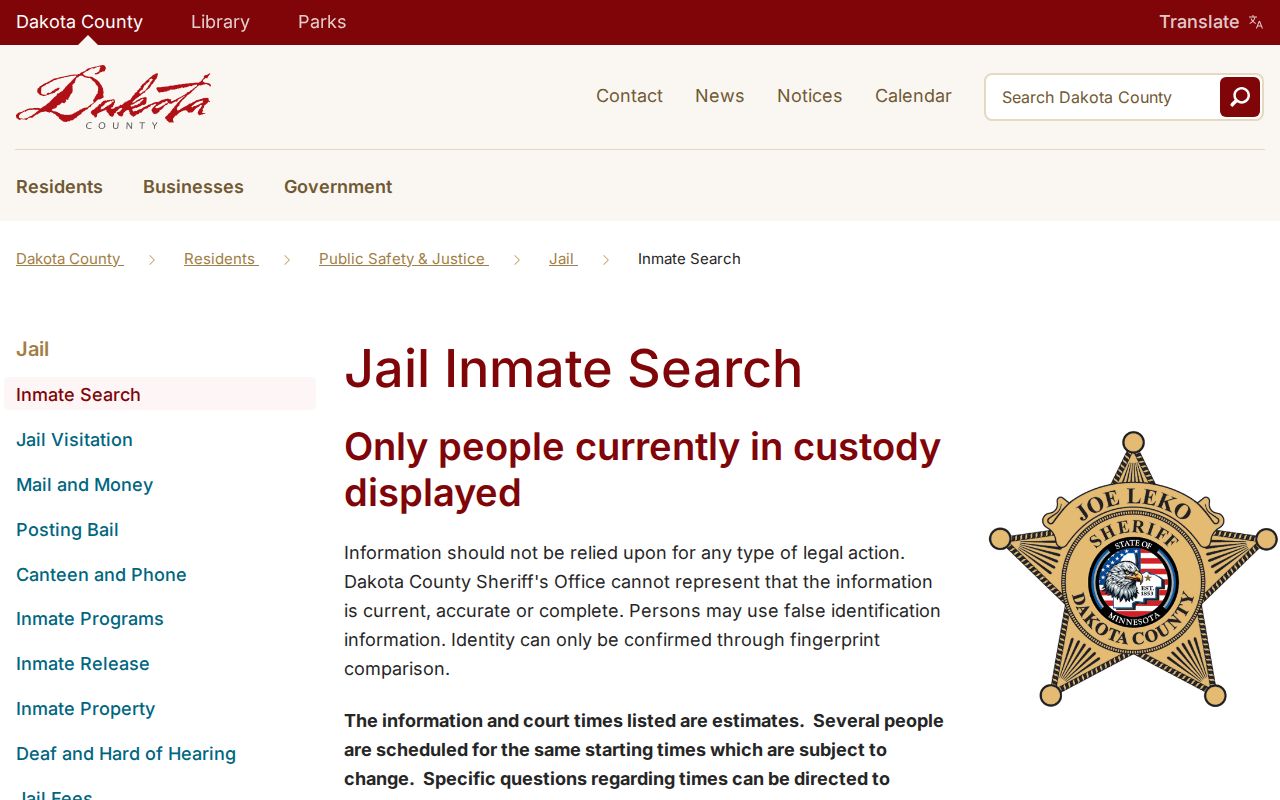
Keep a custody entry separate from any court outcome. A custody display, a complaint, a filing, and a disposition each mark a different event in a Dakota County case.
Dakota County Court Counter Records
Remote case access stops at a firm line. Under the MCRO access rules, online results are unofficial. Records before July 1, 2015 are sparse on the web. Restricted categories may be withheld. A blank remote screen is not a full history. So treat it as a first look. The court counter and statewide public terminals fill the gap. They reach older files, locally stored paper, and certified copies. Records held off site may take longer than a day to pull.
Hastings Judicial Center
1560 Highway 55, Hastings
651-377-7180
Use the court counter or public terminals for the authorized file or certified-copy route.
Apple Valley Western Service Center
14955 Galaxie Avenue W, Apple Valley
952-247-7099
Use the court’s local service path when the record is held there.
The Dakota County District Court page lists the court locations serving the county. It also carries the public calendar information. Ask court administration for copies only after you gather the essentials. Those are case number, court location, party name, filing date, and document name. Say whether the copy must be certified or non-certified. That choice changes how the request is filled.
Note: Before reporting an empty MCRO search, record the query date, the remote coverage limit, and any excluded case categories.
Dakota County Vital and Voter Records
Minnesota Find My Registration answers a narrow question. It confirms whether one person is currently registered, nothing more. The lookup asks for first and last name, full date of birth, city or township, house number, and street. It also asks for either ZIP code or county. Pick the unit option and a unit number becomes required. Updates run nightly, though a brand-new application can sit unprocessed for up to 14 days. The result is a confirmation, not a resident list. Minnesota Statute §201.091 limits how public voter lists may be used. It also keeps full dates of birth and identity numbers out of the public-list fields.
Birth and death records follow a different path. The Minnesota Department of Health reports births from roughly 1900 forward. It reports deaths from roughly 1908 forward. Dakota County service-license centers can route eligible requests. But MDH itself handles statewide and designated adoption requests by mail or fax, never by email. Certified birth access is restricted under Minn. Stat. §144.225. Death records are public, yet a certified copy still carries request and identification rules. Marriage certificates come from the county that issued the license. A divorce decree sits with the district court that granted it.
A historical index can offer a spelling lead. It can also offer an event date, not permission to publish a certificate. When an older Dakota County name is the starting point, the MNHS People Records search and local archives make a solid alternative. For adopted people, the adult adopted-person procedure in §144.2252 is the official route. Working around confidential information through a public index is not.
Dakota County Court Research Gaps
MCRO's limits shape any Dakota County court research. Remote coverage thins out before 2015. Several sensitive categories are omitted or restricted. Party street addresses and comment fields never appear. Pending criminal, traffic, and petty-misdemeanor matters can also slip past a defendant-name search. So a name missing online is a negative result within stated portal coverage. It is not proof that no record exists.
The same caution travels beyond court records. RecordEASE's abstract index reaches back only to July 8, 1993. Its post-login controls demand an account. A county property card names an owner and mailing information, not the people living there. For historical households, the Dakota County Library, the Dakota County Historical Society, or MNHS collections may fit better. Search paths shift with the source. A second official identifier beats an added guess every time.
Dakota County Records Privacy Limits
Minnesota's Government Data Practices Act, Minn. Stat. ch. 13, splits data into public, private, and nonpublic classes. When a portal lacks a public record, send a narrow request to the actual custodian. Identify the record, the date range, the fields wanted, and whether inspection or a copy is preferred. Dakota County's public-data request form provides the routing path. A denial should state its legal basis, and a request may return with redactions or nonpublic material separated out.
Some gaps and mismatches are deliberate. Minnesota Safe at Home gives participants a substitute address with mail forwarding, and voter safety withholding can pull a voter from public display. A different address is not bad data. Never try to reverse-locate a participant. Court exclusions, vital-record confidentiality, and protected identifiers set real limits on what any record search can show.
Lawful personal use. Use Dakota County records for personal, lawful research and preserve the source’s limits. Do not use a result to stalk, harass, intimidate, or expose protected information about any person.